Loski Internacional
From farm to cup, every step verified
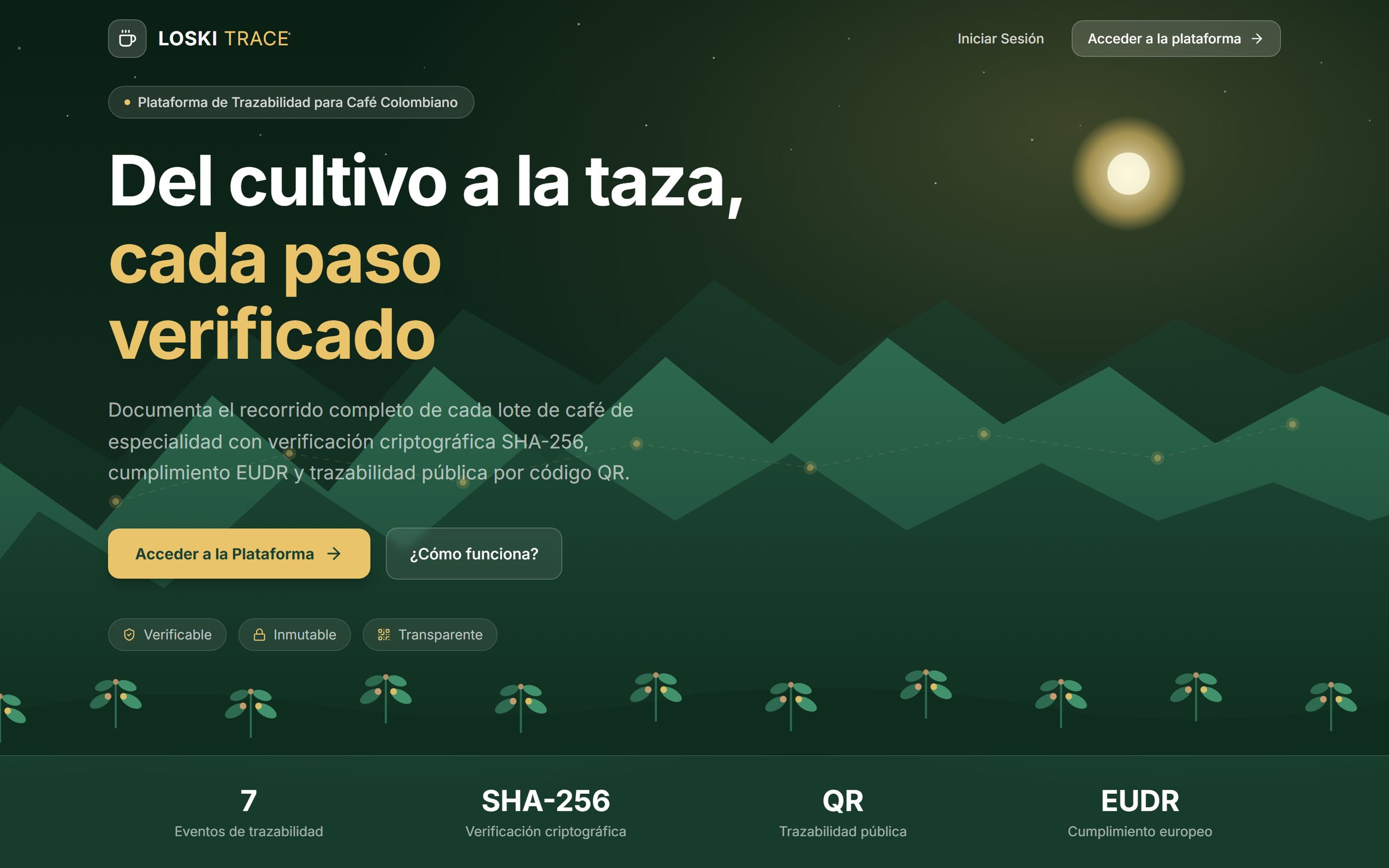
In four weeks we built LOSKI TRACE, the traceability core for a Colombian specialty-coffee exporter. Every lot gets a structured code and an immutable chain of events — harvest, drying, bagging, dispatch, delivery — tied to geo-referenced farms and satellite-drawn plots, with photo evidence, documents and a public QR any buyer can scan to verify the full history with SHA-256 integrity checks. EUDR-ready, on infrastructure the client fully owns.
Duration
4 weeks · delivered March 2026
Completed
March 27, 2026
First commit Feb 28, MVP live in production Mar 27, 2026
Created, harvest, drying, bagging, dispatch, delivery and correction
PostGIS points and polygons with spatial and full-text indexes
11 NestJS modules with 56 stable domain error codes
Loski exports Colombian specialty coffee.
International buyers — and, since 2025, the EU Deforestation Regulation (EUDR) — require proof of where each lot comes from: which producer, which farm, which plot, how it was processed, and that the plot is free of deforestation. That information lived on paper, loose photos and spreadsheets, with no guarantee it had not been edited afterwards. The client was explicit: the MVP could not be a prototype. It had to be the definitive core, ready for IoT, satellite validation and smart escrow without a rewrite.
- — Buyers and the EUDR demand lot-level proof of origin, geolocation and deforestation-free status
- — Supply-chain records lived on paper and spreadsheets, editable by anyone, with no audit trail
- — Smallholder producers, rural farms and a field team working mostly from phones
- — The MVP had to be the definitive core, fully owned by the client, ready to grow without a rewrite
Six systems delivered as one platform in four weeks, deployed on the client’s own Supabase, Vercel and Render accounts with its own domain.
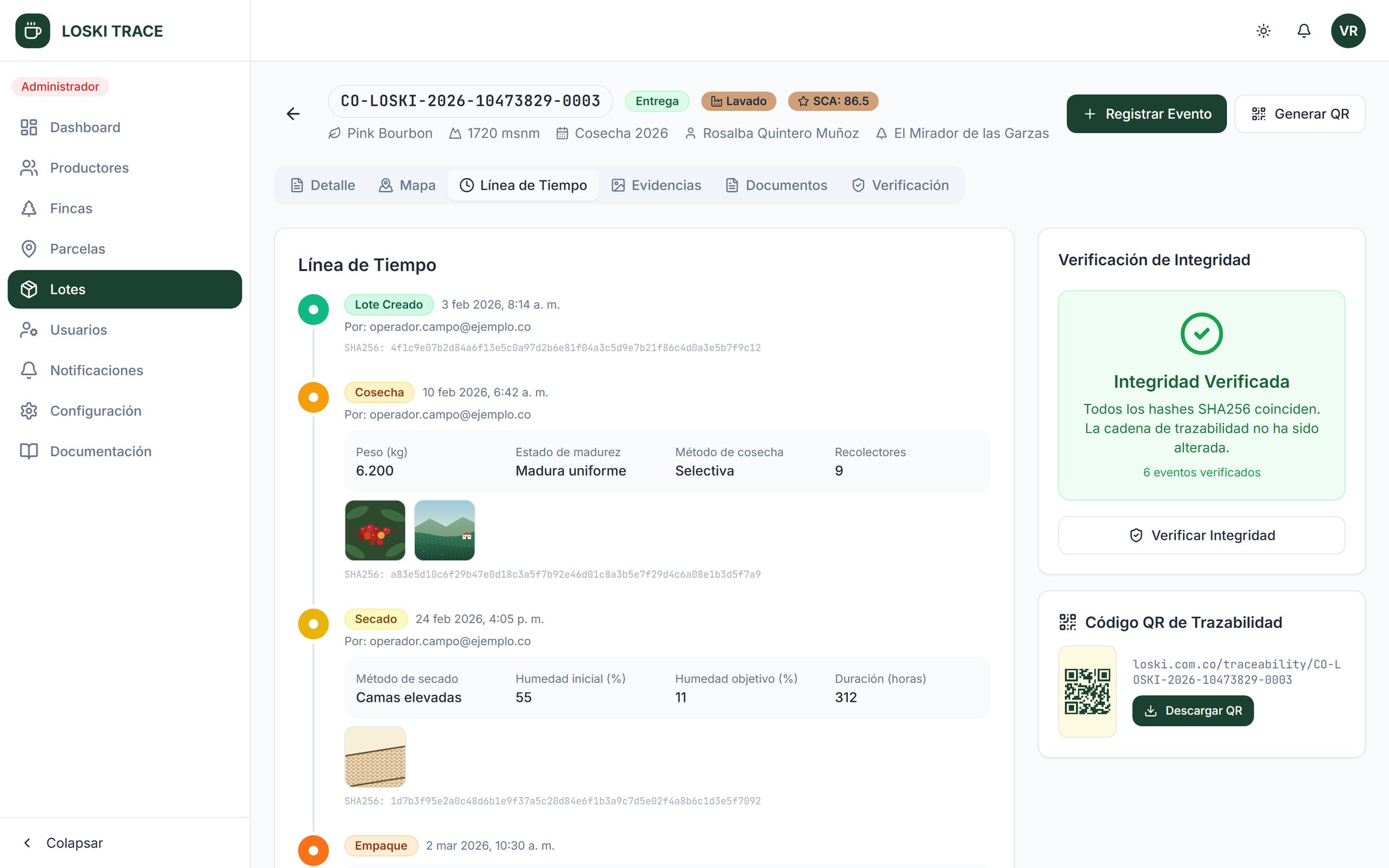
- + Event-sourced traceability engine · each lot is a timeline of seven lifecycle events, enforced in order and immutable at the database level; mistakes are fixed with a correction event that references the original
- + SHA-256 integrity layer · every event sealed on the server and verifiable by anyone, including buyers through the QR, with backward-compatible verification
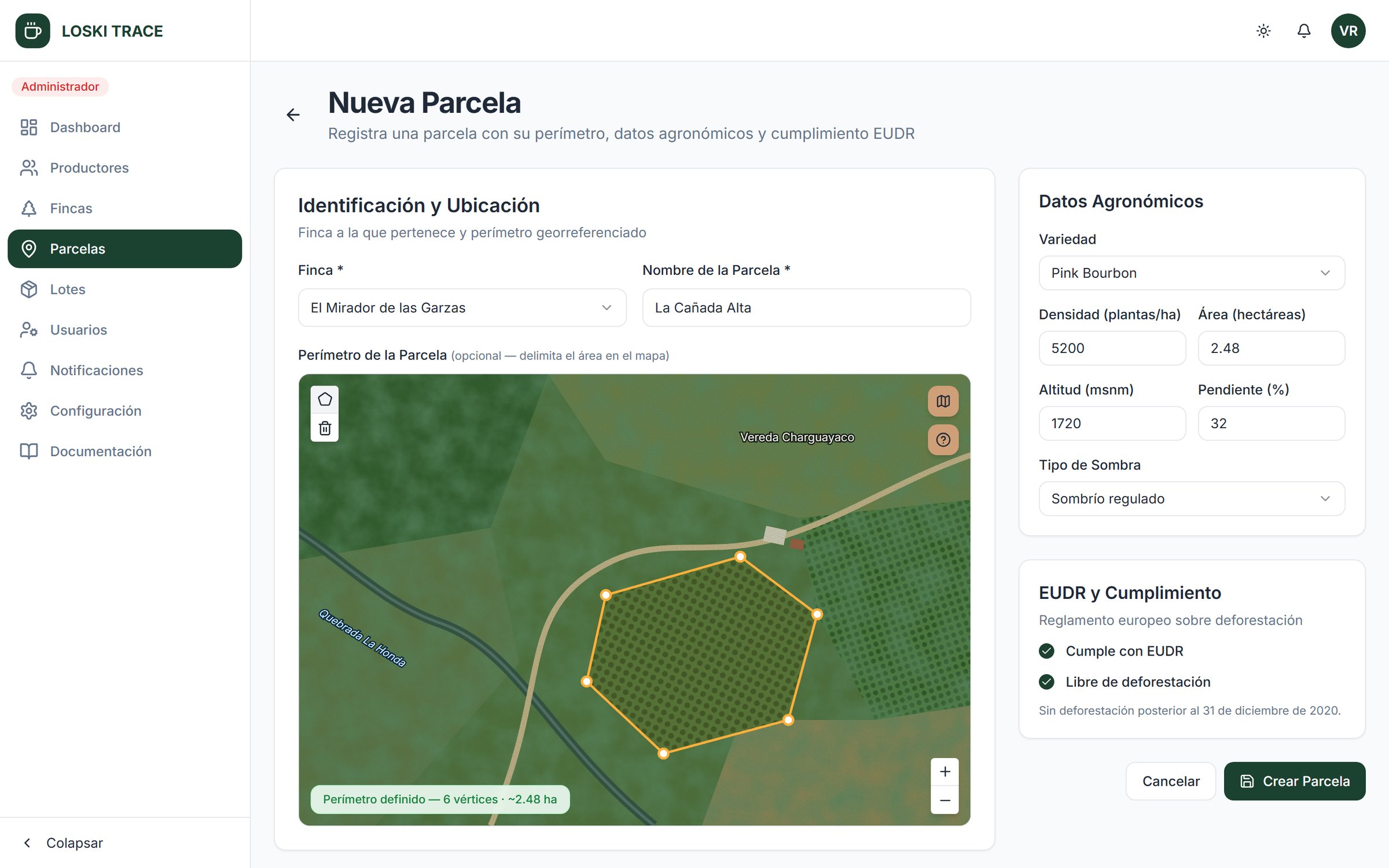
- + Geo-referenced registry · producers, farms with 30+ fields (SICA, FNC, ICA, CAR) and plots drawn as polygons over satellite imagery, with EUDR deforestation-free flags
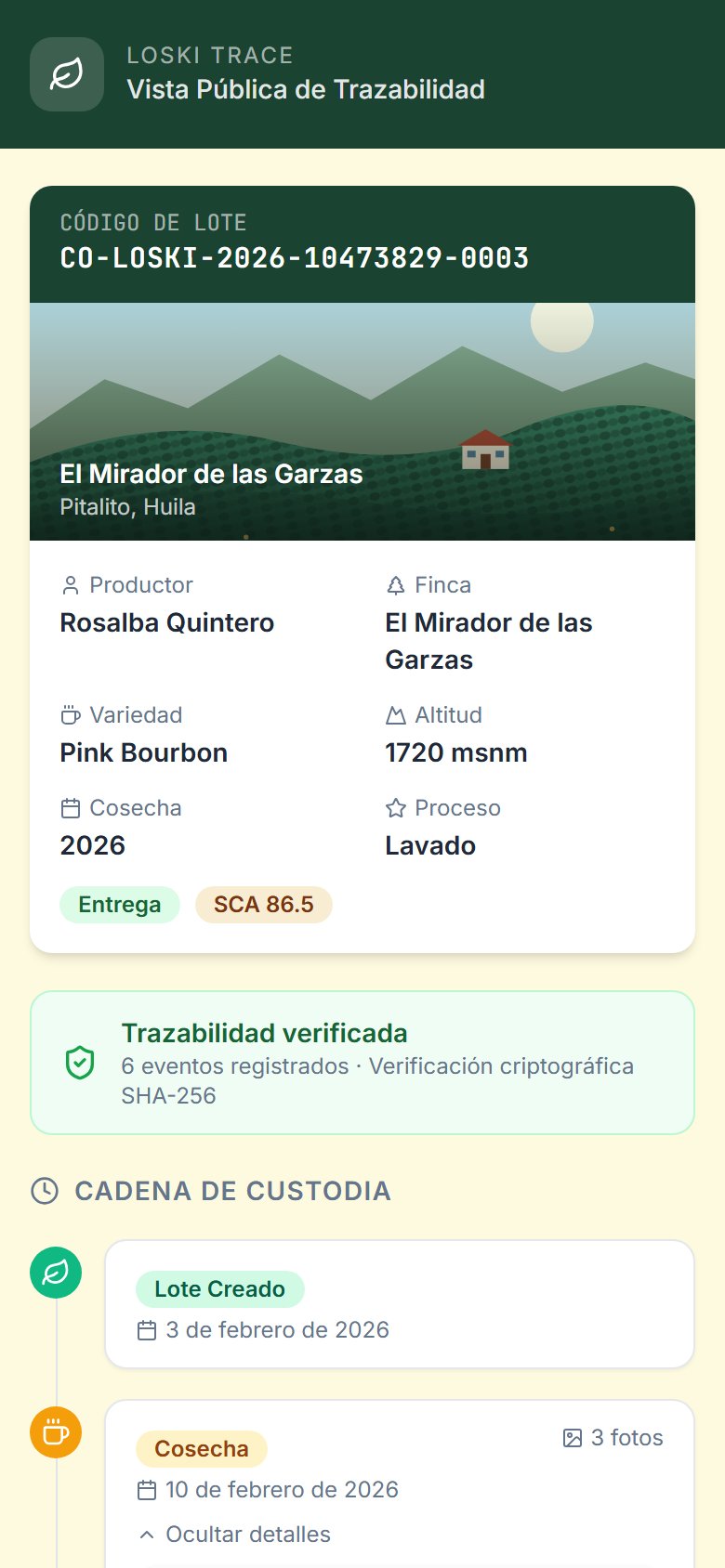
- + Lot identity and public QR · structured lot codes generated atomically and a scan-to-verify public history that hides sensitive data by design
- + Evidence and documents · event photos and lot documents (phytosanitary, origin, quality, transport, invoice) uploaded straight to storage through signed URLs
- + Invitation-only access · three roles (admin, operator, producer), a dedicated producer dashboard, and transactional email for invites, new events and completed lots
Inside the build.
Brand, interface and system — shown as they shipped.
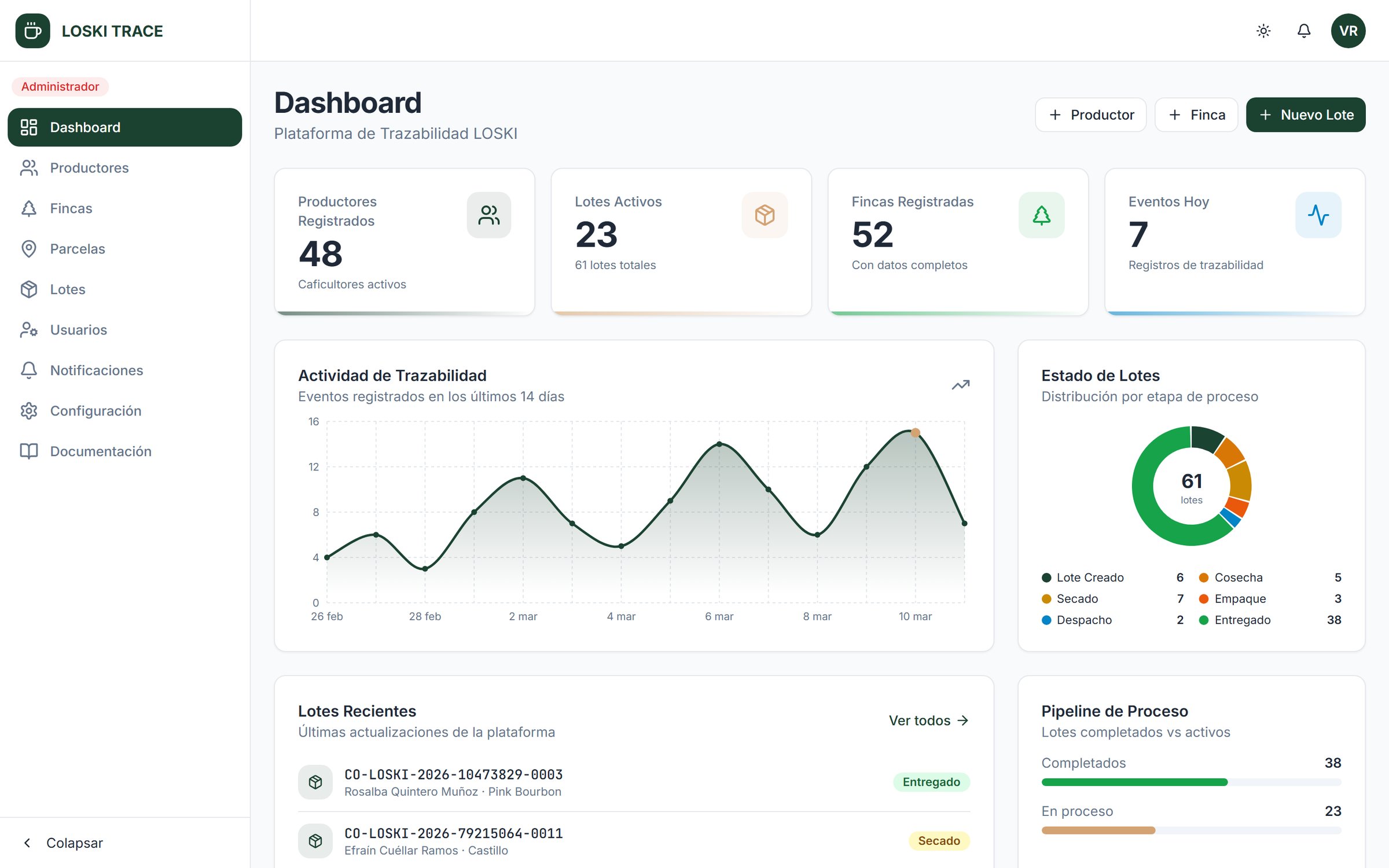
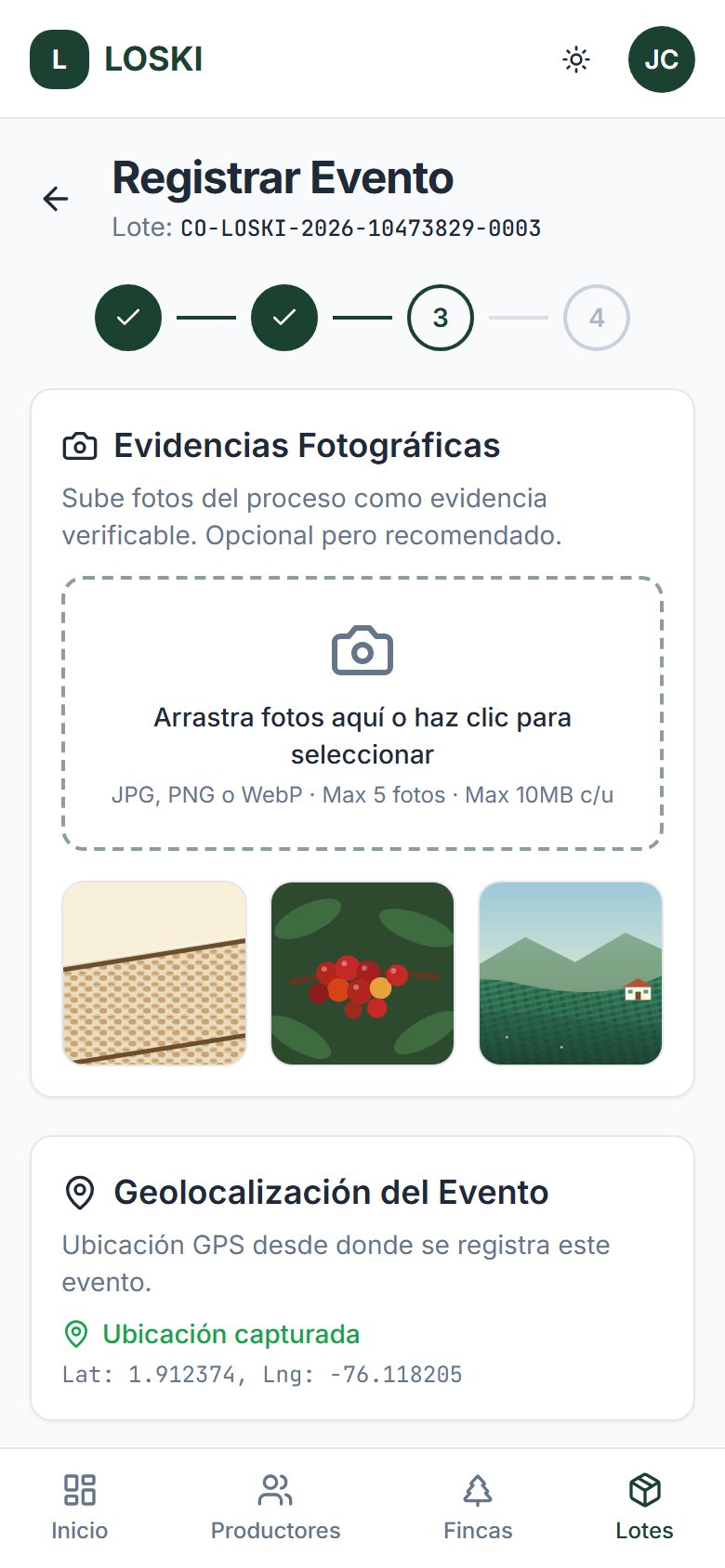
A data model that refuses to forget.
LOSKI TRACE is not a dashboard. It is a traceability data model with its business rules encapsulated in the database — triggers, an atomic RPC, row-level security — and in a NestJS API with strict validation. Roughly a third of the code, and most of the engineering decisions, live below the UI.
Immutable by trigger, not by good intentions
A PostgreSQL trigger makes it impossible to edit or delete an event, even with direct database access. The required event order lives in a shared package used by both the API, which rejects out-of-order events, and the wizard, which blocks and explains.
Deterministic hashes across layers
Postgres and Node format timestamps differently, which produced false “tampered” alerts. Timestamps are normalized and metadata keys sorted before hashing, and verification stays backward-compatible so no historical hash is ever invalidated.
Lot codes without race conditions
An atomic upsert on a per-producer, per-year sequence table generates each code, and a self-healing version recovers if the sequence ever drifts.
Privacy by design in the public view
The QR shows the story, not the sensitive data: no ID documents, no coordinates, no prices, no buyers and no documents leave the private platform.
Built to grow without a rewrite
Every event already records its source — manual, IoT or API — and an external reference. Sensors, satellite checks or an ERP can plug in as new event types, exactly as the spec required.
Hybrid AI Coding
Senior engineers own the architecture, the data model and every decision with the client, while AI agents accelerate implementation under independent review. That is how a definitive, production-grade core shipped in four weeks.
Technologies & Tools
The tech stack powering this solution


Beyond the numbers, we delivered a system that transformed how this client operates.
Proof of origin, built in
Every lot carries a tamper-evident history, from the plot polygon to the delivery dock, that a buyer can verify with a phone camera. The database itself enforces that integrity, not a process.
EUDR-ready from day one
Geo-referenced farms, satellite-drawn plot boundaries and deforestation-free flags give Loski the data foundation European buyers and regulators now require, without a separate compliance tool.
A core that grows without a rewrite
The event model already anticipates IoT sensors, satellite checks and external systems as new event sources, on infrastructure Loski owns end to end.
- Feb 2026Spec for the definitive architectural MVP, agreed with the client
- Feb 28, 2026Monorepo, data model, row-level security, triggers and the atomic lot-code RPC; backend and dashboard start the same day
- Mar 3, 2026SICA, FNC, ICA and EUDR fields across producers, farms, plots and lots
- Mar 11, 2026Public QR view, email notifications, profiles and maps
- Mar 14, 2026Backward-compatible integrity verification, role-based dashboards and the producer experience
- Mar 27, 2026Handover: code, database, hosting and domain on the client’s own accounts
Ready to achieve similar results?
Let's discuss how we can transform your business with a tailored digital solution.